
WOOL-ON-SHEEP TO WOOL-ON-HUMAN
THE DIRECT-INDIRECT AFFORDANCE OF NATURAL MATERIAL TO HUMAN
2023
Foreword
We see, we feel, and we perceive. We perceive the flourishing world by looking at and interacting with the creatures, the materials, and the artefacts, yet we never forget that half of our world is overhead. Stargazing is my favourite way to connect me with nature, the environment I am presencing. The feeling of awe at the vastness of the universe expanded my perception away from myself. Looking at those stars whose lights have travelled for millions of years then they could be observed by us, they are from history. In the spring and summer of Canada, you can always observe Arcturus, the brightest star in the northern hemisphere, which lies beneath the belt of Boötes. While every constellation has its own story and meaning dating back to ancient times, Boötes means "herdsman" or "shepherd" in Sumerian (Jijelava et al., 2016). Awe could enhance creative thinking (Chirico et al., 2018), and looking at the Boötes in the sky brings me an image of the Sumer herdsman herding his livestock. When I learnt that Sumerians in Mesopotamia could be the first to use wool to conceal their bodies and create textiles (Sallaberger, 2014), I started to think about how they could know that wool could be worn and brought them warmth and comfort that was different from linen. Therefore, I would like to use the affordance theory from J.J. Gibson (1977) to investigate how the Sumerians might perceive the affordance of wool.
From Gibson’s theory, the environment stimuli through ambient light offer directly perceived affordance by optical to the perceiver. In this article, the Sumer herdsman perceived the wool textures, colours, and appeared regions, while different environments and situations gave him a different optical perception of wool, which perceived affordance could also be hidden, or “false”. He observes, then he actions, which the optically perceived affordance affords. He touches the wool. Touching and feeling, are sensory perceptions that Gibson has never mentioned. The texture and mass of the wool stimulate the sensory cells and provide the herdsman with a perception. In the first two sections of this article, the herdsman’s knowledge of the wool on his sheep is discussed through Gibson's directly perceived affordance theory, optically and tactilely. The direct perception of tactile sensory is discussed based on Gibson's direct perception of optical sensory, associated with scientific research on how the body touches and senses, biologically and psychophysically.
Based on the case of the Sumer herdsman and his wool, we discuss the connection between the human body, the object, and the environment, the niches in the third section. From optic to tactile, from a directly perceived basic affordance to another basic affordance, while these basic affordances of wool could never change but changing the perceived angles, and the herdsman’s, or our intentions. However, there are limitations to directly perceived affordance, that it could be affected by the optic and tactile sensory when the appearance and handle are being modified. Then we have to perceive the wool indirectly, through our past experiences, or experiment, to learn the affordances of wool. Escaping from its natural form, this wool becomes an artefact, connecting with culture and society. A description-of-affordances model is discussed in the fourth section and is applied to help the user understand the knowledge and social relations to perceive the wool’s affordance with different descriptions. The activity opportunity, use opportunity, and manipulation opportunity of the yarn, or the knitted garment, should be perceived by us, the user, and then the affordance is present from the user’s point of view.
The chain from direct to indirect perception, the progress of perceiving the affordance of natural material to its artefact, should be whole in the material world complete with artefacts. From direct biological to indirect social and knowledgeable perceptions, the network of affordance becomes more comprehensive and dynamic. But if we return to the Sumer herdsman, all we need could be the receivers, the object, and the environment, the pure and direct affordance of raw wool.
The Boötes and Wool
“Baa - --”
On a sunny day, a Sumer herdsman is grazing his sheep in his pasture. A sheep is jumping into him, and the sunlight brightens the wool on the sheep. He then first ever noticed the wool grown on the sheep. The wool is moving by the wind and looks shiny under the sunlight.
Suddenly, a storm arrives. The herdsman rushes the sheep back to the shelter, but the rain in the storm still wets the wool and brings impurities, like sand, between the wool fibres. He notices that the wool's appearance changes after the weather has changed, yet he wants to understand whether the wool is the same as the wool he observed on the sunny day. He touches the wool, and feels it. From this day, he becomes the pioneer who perceives the wool grown on the sheep.
Direct Optical Perception of Affordance from Gibson: Visual
Affordance is the term created by J.J. Gibson in the mid-to-late 1900s that refers to what the environment offers the animals through their direct and immediate optical perception (1979). In this section, the affordance theory by Gibson in his work (1979/1986) Ch.3 (Ch8) The Theory of Affordances will be overviewed, and his statement on the direct optical affordance perception under ambient light will be implanted into the Sumer herdsman’s case to help us investigate how the affordance of wool might be perceived visually.
A General Overview of Gibson’s Affordance Theory
The notion of affordance introduced by Gibson is framed in the situation of direct perception, that comprehensive cognitive processes, such as inferential processes and computation, are not required. The environment provides "affordances" of a substance - possibilities for action or function that are directly perceived by an organism based on its needs, abilities, and intentions, which he called “ecological physics” (Gibson, 1977, 1979). This ecological physics is a substance’s affordance in a specific environment, yet it could not be the only affordance of a substance, and it would not be necessary to be perceived. The affordance of a substance naturally exists, is a fact of the environment which would not be changed by the perceivers, and a fact of behaviour which is an intention-driven perception of the perceivers (Gibson, 1986).
There are four approaches to Gibson’s theory, as concluded by Warren (2005), including the environment, the perception and action, the information, and the perceptual systems. These four sectors indicated how direct affordance is perceived and functioned.
The context of the environment frames the perceived affordance, the ecological physics. It could be referred to as the niche that the perceiver is embedded in, and the perceptual system of the organism is tuned during evolution and learns the simulation patterns from the environment to receive messages that assist it in competently inhabiting the environment (Warren, 2005). For example, the perceptual system of fish is the lateral line organ tuned to perceive the vertebrates of water displacements generated by the obstacles, predators or prey, and the neighbour (Neff, 1974; Warren, 2005). The perceptual system of our Sumer herdsman has been tuned to perceive the photons that carry information, such as frequency, which affect the colour we perceive, and the spin, the location, and the wave phase (Baird, 2015). What the herdsman perceived visually is the passive action of photons reflected by a substance under a vast, bright environment (the pasture), that the “sheep” he observed is a bunch of photons that have reflected off and have been arranged in a pattern that resembles the sheep. When the rod or cone cells covering the retina receive the message from photons (Baird, 2015), the herdsman could immediately perceive the affordance of the sheep: stumbling, hugging, or petting (Figure 1). If there is no reference to the perceiver’s environment and the available stimulations, the perception might not be aware (Warren, 2005).
Figure 1
The directly perceived affordance of the sheep.

Note: The sheep could afford the actions of (i) stumbling, (ii) hugging, and (iii) petting.
When affordance is perceived, it has to be an activity of perceiving, the perception and action relation. Gibson gave examples of the substance’s affordance, such as a stream or lake not affording support for standing but for floating or swimming (Gibson, 1977). Standing, floating, and swimming are the resulting actions of the perceiver after perceiving the affordance of the substance. Without actions, locomotion and manipulation, the optical perception could be the passive recipient of sense impressions from the environment (Warren, 2005).
We perceive in order to move, but we also move in order to perceive. (Gibson, 1979, p.223)
The perceived affordance is pragmatic and task-specific to the perceiver (Warren, 2005). The perceptual systems shaped by the particular ecological niche could perceive the affordance compatible with the perceiver’s ability: the sheep could perceive the edibility of fresh grass grown on the soil, which its teeth could tear, its mouth could reach, and its stomach could digest. Similar to the Sumer herdsman’s case, he could perceive the warmth and softness of the wool on the sheep, that his hand could touch, his fingers could rub, and his skin could sense. If the affordance cannot be acted upon, it cannot be perceived. If the wool is grown on an eagle in the sky but not on the sheep, our herdsman could never understand that wool could offer warmth and softness, as he could not touch or feel it. The veridicality of direct perception guides action, such as touch, to sense softness, but not the accurate judgments of physical properties, such as the keratin of the wool offers hydrophobic features. In addition, these actions are generated from the directly perceived affordance based on the persisting features in the environment (Warren, 2005), such as the fish being in perceptual contact with the obstacles but not the vibration, and the herdsman with sheep and wool but not the photons. This is a perception with the intention connected to the phenomenon of perceptual constancy, such as the shape and colour of the wool, which can appear differently when we, the perceivers, are moving (Gibson, 1979; Warren, 2005). Therefore, the self-motion, the action, allows the perceiver to understand the relations of “objective” perception of constant substance in the environment and their variable appearances received by the mobile "subjective" perceiver, and that is what Gibson mentioned about “An affordance cuts across the dichotomy of subjective-objective… It is equally a fact of the environment and a fact of behaviour” (Gibson, 1979, p. 129).
Ecological information is the specificity received from the ambient optic array structured and specific to a situation or niche (Gibson, 1979; Warren, 2005). This specificity means that the perceived environmental information forms the higher-order patterns of stimulation that a given property, such as the surface shape of the wool, could be specified by variables, such as crimp, staple texture, and shading, across a series of modalities, including vision and haptics (Warren, 2005). The information may also specify environmental properties by virtue of local constraints in an ecological niche (Warren, 2005), such as the touchable wool grown on docile sheep being herded.
Last but not least, the perceptual system is an active organ which searches for and collects environmental information from the ambient optic array (Gibson, 1979; Warren, 2005). The affordance is perceived not only by the cells and retina of the eyes but also by the range of motion of the eyeballs and head, the contraction and relaxation of the muscles, and the self-motion of the perceiver (Warren, 2005). The photons are reflected off the substance and received by our eyes, and we perceive the affordance; it is a passive action, an “objective” environment. When we roll our eyes and turn our heads to receive photons reflected off a specific substance in a specific environment, it is an intention-driven perception, an active action, a “subjective” self. In the case of our Sumer herdsman, he could perceive the coarse britch wool on the hindquarters of the sheep, but he could also control his eye muscles and look to the front shoulder of the sheep and perceive the cleaner and finer wool.
These four approaches to Gibson’s theory are also based on the frame of an “ambient optic array”. In the following section, the direct optical perception under this ambient light will be reviewed in the case of our Sumer herdsman.
Optical Perception under Ambient Light
The ambient optic array is the structure of ambient light which specifies an affordance from the basic properties of the environment (Gibson, 1979). This array must be different in different directions for the visual-perceptual activity to proceed (Gibson, 1979; Natsoulas, 2004). Gibson (1986) stated that the availability of information perception under ambient light is a central question. Therefore, we will investigate how the information could be optically perceived under ambient light in the case of Sumer and the wool.
The ecological environment is first identified: What could be in the niche? In Mesopotamia, sheep from family farms were kept in small areas of pasture in the steppe or in stables (Sallaberger, 2014). We can imagine that there are wooden fences with metal nails (Lapérouse, 2008), or the “Albaryia“ (reed-mats) (Al-Asadi, n.d.), or natural barriers, such as trees and rocks, that restrict the livestock’s movement to avoid missing sheep. There are also environmental substances that maintain the life of sheep and provide nutrients, such as grass, river, underground water, and other associated substances like mud, insects, leaves, and faeces. Besides, as the pasture could be in the open air, the weather could also bring other substances or elements, like the rain bringing water, and the wind bringing sand. All these elements and substances in the ecological environment could function for sheep herding, provide shelter, or serve as a source of dirt for the sheep, and could also offer a specific environment for an affordance that the herdsman perceives.
Suppose the herdsman is with the sheep on a stormy day (Fig 2). The sand brought by the wind is captured by the wool fibres, and the rainwater brought by the storm wets the wool fibres, causing them to collapse. Our herdsman perceives the wool as entangled with impurities and sand under the ambient light, yet the light is dim because of the heavy cloud, and the lightning brings a flash of blue-white light on the wool. In this ecological environment, the information of the wool from the ambient optic array received by the herdsman could be the collapsed fibre crimps, high contrast fibre shading, and a rigid texture with impurities, in vision, and this information specified higher-order patterns of stimulation, which could be a gnarled angular shape with a cumbrous feeling on the wool. With this information, some affordance of wool, like warmth and soft, could be hidden, and the herdsman might perceive a “false” affordance like heaviness and scratch, yet the basic affordance of touch could still be perceived.
Figure 2
The sheep on a stormy day, with half of its body staying in the shelter.
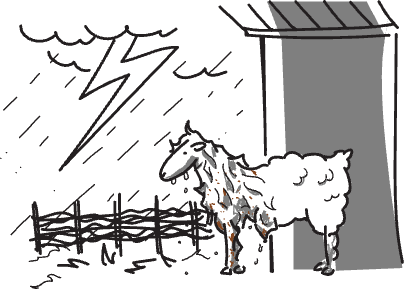
From the previous section, we learned that affordance could also be intention-driven and perceived through the perceptual system, the visual system. The information received is framed by the visual focus, which is controlled by the eye muscles. When the visual focus of the herdsman is shifted, then he can observe the dry wool that has not been affected by the storm, which information from the ambient optic array received by the herdsman could be the wavy fibre crimps and smooth texture in vision, and specified a bulky shape of the wool in stimulation.
After the herdsman has perceived the affordance of wet and dry wool from the ambient optic array, he takes action. Both types of wool afford touch, yet other affordances have to be further perceived, such as the gnarled angular shape with a cumbrous feeling on the wet wool. Even though the optically perceived gnarled angular shape might be related to hardness and stiffness, it might be misperceived. When the wool affords touch, press, or pull, the herdsman gets the opportunity to manipulate the wool. This could refer to another direct perception we will discuss in the following section, the tactile.
Direct optical perceived affordance is the information from the ambient optic array in the specified ecological environment, which could be influenced by the “objective” environment and the “subjective” self. However, the information received under ambient light might not be comprehensive. Further perception is needed based on primary and basic affordance; in our case, it refers to touch, the tactile sense.
Direct Sensorial Perception from Touch and Feel: Tactile
Gibson (1986) emphasised that exteroception, the perception of environmental stimuli from the external, is accompanied by proprioception, the perception of self-movement, force, and body position. These environmental stimuli from the external include visual and tactile stimuli, whose information could be received by receptors, like the photoreceptors in the retina that receive the message of photons. From an optic perspective, our herdsman perceived the affordance of touch and other opportunities for manipulation of the wool. The incomplete information about wool from optical perception could bring misperception, while the tactile perception by the action of touch might help to fill the gap. In this section, tactile perception will be discussed in the case of our Sumer herdsman with the four approaches to Gibson’s theory.
The ecological environment, we could assume, is the same as the one in optical perception. The only difference is that ambient light could be absent in tactile perception. Every element and substance is perceived by tactile; in our case, it is the mechanoreceptors on the skin of the herdsman’s hand. In optical perception, the receptor receives the message from photons which reflect off the substance in the environment. In tactile perception, the receptor receives the message about touch, pressure, vibration, and cutaneous tension (Purves et al., 2001) from the environmental substance. In the ecological environment of our Sumer, he can touch the wool on the sheep to sense the fibre texture and whether it is wet or dry, or he can sense the pressure from the wool covered on his hand, or sense the vibration transmitted from the friction of fibres rubbing with the impurities. Although the herdsman could perceive the tactile senses of wool in the specific ecological environment, he cannot understand how those senses cause and might not distinguish if the perceiving substance is wool when the tactile sense changes. When optical perception could perceive affordance with the association of “seeing” the surrounding environment, the only information of tactile perception is from the receptors on the hand’s skin, which are limited by the size of the hand and can only perceive a specific substance: the herdsman might only perceive the information on the wool, could be the fibre, the trapped impurities, the moisture, but not the wind and the rain in the environment.
Ecological information, in the case of the sense that is received by the herdsman’s tactile receptors, is the contact deformation and vibration in the skin layer when the finger touches or slides the wool surface (Chen & Ge, 2017). The tactile receptors in the skin coded this to action potentials which would be transmitted to the somatosensory cortex in the brain (Chen & Ge, 2017). The action potentials contain information on the ecological environment, the surface texture of the wool. Besides the tactile receptor, the pressure receptor could also receive information about the force applied from finger muscles to the substance, the wool, and the brain could perceive the softness of wool by the applied pressure (Kitada et al., 2019). These are the direct perception paths from converting the information from contact deformation, vibration, and pressure reflected off the substance to the signal the brain could perceive. In addition, the information received by different receptors could be merged and offer other perceptions, such as the sense of wetness. We do not equip the sensory receptor of wetness. Still, the perceived affordance of the cold (thermoreceptor) and the glutinous and the increased friction (tactile), offer our brain a perceptual illusion which, based on previous experience, we could learn that the combination of those perceived affordances refers to wet (American Physiological Society, 2014). Therefore, the affordance of wet wool perceived by the herdsman is not from the wet, or the moisture on the wool, but the perceived cold, glutinous and friction could be its affordance. This received ecological information could let the perceiver, the herdsman, perceive the affordance of the wet wool fibre: the entanglement of these sticky, abraded fibres, or the affordance of the dry wool fibre: smooth sliding afforded by the fine size and aligned texture from received ecological information about contact deformation and vibration, and the compressibility from the softness of the wool fibre.
With those perceived affordances from tactile, the herdsman could act and respond to those affordances. However, the tactile perception itself could be in the relationship of perception and action, that it is a responded action offered by the affordance that is perceived optically. In my view, tactile perception could be the secondary direct perception as it is the result of the basic action the optical perception offers: the wool affords touch. Although it is a perception with a “higher requirement”, it is still a direct perception as the brain directly perceives the ecological information from the substance without the knowledge or cognitive memory. The information itself is the stimuli in tactile perception. Since tactile perception is a result of an action, it could guarantee that the affordance perceived by the tactile sensory could also be acted. Still, there is not only the “objective” perception of constant environmental substance with a static position of action, but the “subjective” self of the perceiver could move and change the position or location, that the constant environmental substance might no longer exist in the specific environment, in which the affordance could be invalid.
Similar to optical perception, the perceptual system in tactile is framed by the passive sensory receptors and the intention-driven movement to muscles, influencing how and what environmental message could be received and perceived affordance. It includes the mechanoreceptors, which passively receive information about touch, pressure, vibration, and cutaneous tension (Purves et al., 2001) from the “objective” environment, and the “subjective” self that the intention drives motions of hands and fingers to receive information from a specific substance or environment. Yet, the tactile sensory could not provide enough information for its perceptual system. Tactile might not sense and understand where the substance is during the intention-driven movement, which could also present an invalid affordance.
Tactile perception is the result of the responded action of the optically perceived affordance. Furthermore, the affordance perceived by the tactile sensory could also be indirectly perceived by optical, which could be referred to as cognitive recognition. The following section will briefly review this indirect perception of tactile affordance with examples of wool.
Indirect Perception of Tactile Affordance by Optical
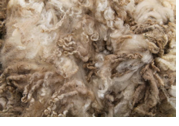
When we observe, we can perceive the affordance that could afford action, but the affordance that originally should be perceived by other perceptual systems could also be perceived—in this case, the texture of wool. In part on ecological information in optical perception, I mentioned that the higher-order patterns of stimulation could be specified by variables, such as shading and texture. At this point, the texture might not be directly optical perceived by a person who has never perceived such appearance, and texture could not connect the image he should receive by the eyes and the sense he should receive by the hand. The information he received from the photon could be the shape and shading, the fibre bundles with angles and high-contrast shadow (Figure 3, ii), or the filaments with large wavy shapes in light colouring (Figure 3, i). Without cognitive recognition or experience of the tactile sensory to such perceptions, the affordance could only be restricted by the optical perceptual system. The affordance could only be indirectly optically perceived under ambient light once there is associated memory or cognitive recognition in the processor, the brain.
Figure 3
Wools in different appearances.

(i)
(ii)
Note: (i) is the wool image from Chernetska (2021); (ii) is the wool image from Daseaford (2020)
Nonetheless, the affordance perceived through this path could be a perceptual illusion, like the wetness, as the associated perceptual system has never perceived it under the specific ecological environment, in which the “perception” that generates the affordance is based on the previous experience which might not be compatible with the current, specified ecological environment.
From Nothing to Something
From the previous sections, the perceptions of both optical and tactile guided the herdsman in perceiving the affordance of wool. In the beginning, our herdsman had never thought about what he could do with the wool, or what the wool meant to him. The only affordance of the wool he perceived could be “observe”; it affords aware to it under ambient light. To the herdsman, the wool is like the constant ecological information that he has only a passive “objective” perception of. As there was no intention to look at the wool, the motion of the herdsman’s eye muscles would not intentionally focus on the wool, which is perceived as randomly driven. Hence, there is nothing; the wool did not have an actual affordance to the herdsman.
When the day the herdsman received the photon that reflected off the wool, he perceived, and he became aware. The ecological elements in the specified surrounding environment, the niche, provide varieties and information on the wool, which can be perceived in a bulky form, entangled with impurities, or in a collapsed shape. The ambient optic array is the stimulus to let the herdsman perceive the wool with specificity. The herdsman perceived the wool affords action, touch. He actioned, and he touched the wool. Meanwhile, the tactile perception could be valid, as the act of touch could afford perception, with the perceptual system, which includes the mechanoreceptors and the range of the hand’s motion. In addition, the affordance of wool he tactilely perceived could offer the opportunity for manipulation. This opportunity for manipulation could afford a higher level of affordance, such as affords effect, affords use, and affords activity (Pols, 2012), which will be discussed in the following section.
From Something to Everything
The herdsman optically and tactilely perceived filament or staple wool that affords combing and twisting, and the natural environment, the wool, is modified by the man from its natural form and contour (Gibson, 1986). These affordances could be optically perceived as the shape and pattern, and tactilely perceived as the softness, smoothness, and bendiness. This information specifies the higher-order pattern, that the wool affords combing and twisting. It is a starting point of the affordance transition from manipulation to an effect in the descriptions-of-affordances-model presented by Pols (2012). When the wool affords combing as an opportunity for manipulation, it affords an effect, which the combed fibres gather and become a sliver. The wool sliver could then afford use under a planned action; in this case, the sliver could be twisted into a yarn. In the final stage of the descriptions-of-affordances-model (Pols, 2012), the wool yarn could afford activity and be involved in social action, such as knitting a garment in the manufacturer.
This model, presented by Pols (2012), converts the natural material, the wool, from affording basic actions to comprehensive social activity. This transition is the chain of the affordance perception of a substance: from directly perceived affordance, which offers the basic properties and functions, to the indirectly perceived affordance, in which the cognitive recognition, knowledge, and memory from past experience are required to the associated perceptual system and perceive the higher-order affordances, such as the social action. From this chain, the connection between perceptions and affordances indicates the indispensability of both direct and indirect perception.
Back to the Prehistoric
A substance could afford effect, use, and even activity, yet the basic affordance frames all these affordances, which is the basis of the pyramid. The Sumer herdsman observed the wool on the sheep and, through his optical perception of its touchability, opened the gate to other higher-order affordances. If the primary affordance was not perceived under the ambient light, all the following perceived affordances could be invalid.
In conclusion, this article reviewed the affordance theory from Gibson (1979) that embedded the story of the Sumer herdsman who first perceived the affordance of wool on his sheep. Optical and tactile perceptions are introduced with the four approaches to Gibson’s theory from Warren (2005): ecological environment, information, perception and action, and perceptual system. These approaches are illustrated by the case of the Sumer herdsman, in which the “objective” perception of the ecological environment and the “subjective” perception of the perceiver's self influenced the perceived affordance in the specified environment.
The basic affordance, directly perceived by biological senses, receptors, and processors, enables associated actions, which in turn afford a higher-order affordance in the descriptions-of-affordances model presented by Pols (2012). The connection between the primary affordance perceived by direct perception and the higher-order affordance perceived by indirect perception, together with cognitive recognition and knowledge, framed the affordance transition chain of a substance.
References
Al-Asadi, J. (n.d.). WOMEN AND CRAFT INDUSTRIES IN THE MARSHES OF SOUTHERN MESOPOTAMIA. THE RAMSAR CONVENTION SECRETARIAT. Retrieved April 23, 2023, from https://www.ramsar.org/fr/women-and-craft-industries-in-the-marshes-of-southern-mesopotamia
American Physiological Society. (2014). Why wet feels wet: Understanding the illusion of wetness. https://www.sciencedaily.com/releases/2014/10/141001133416.htm
Baird, C. S. (2015). Can humans ever directly see a photon? Science Questions with Surprising Answers. https://www.wtamu.edu/~cbaird/sq/2015/09/03/can-humans-ever-directly-see-a-photon/
Chen, S., & Ge, S. (2017). Experimental research on the tactile perception from fingertip skin friction. Wear, 367–377, 305–314.
Chernetska, L. (2021). Soft white wool texture as background, closeup. https://www.istockphoto.com/photo/soft-white-wool-texture-as-background-closeup-gm1308791730-398676557
Chirico, A., Glaveanu, V. P., Cipresso, P., Riva, G., & Gaggioli, A. (2018). Awe enhances creative thinking: an experimental study. Creativity Research Journal, 30(2), 123–131.
Daseaford. (2020). A Background Image of a Freshly Cut Sheep Wool Fleece. https://www.istockphoto.com/photo/sheep-wool-fleece-gm1257399597-368484738
Gibson, J. J. (1977). The theory of affordances. Perceiving, Acting and Knowing: Towards an Ecological Psychology, 67–82.
Gibson, J. J. (1979). The Ecological Approach to Visual Perception: Classic Edition. Houghton Mifflin.
Gibson, James. J. (1986). The ecological approach to visual perception. Lawrence Erlbaum Associates.
Jijelava, B., Holbrook, J., & Simonia, I. (2016). Astronomical context of Georgian folklore. Indian Journal of Science and Technology, 9(37). https://doi.org/10.17485/ijst/2016/v9i37/94312
Kitada, R., Doizaki, R., Kwon, J., Tanigawa, T., Nakagawa, E., Kochiyama, T., Kajimoto, H., Sakamoto, M., & Sadato, N. (2019). Brain networks underlying tactile softness perception: A functional magnetic resonance imaging study. NeuroImage, 197, 156–166. https://doi.org/10.1016/j.neuroimage.2019.04.044
Lapérouse, J. de. (2008). Metallurgy: Early Metallurgy in Mesopotamia. In Encyclopaedia of the History of Science, Technology, and Medicine in Non-Western Cultures (pp. 1624–1634).
Natsoulas, T. (2004). “To See Things Is To Perceive What They Afford”: James J. Gibson’s Concept of Affordance. The Journal of Mind and Behavior, 25(4), 323–347.
Neff, W. D. (1974). Session AA. Physiological Acoustics II: Symposium on Structure and Evolution of Auditory Receptor Organs in Vertebrates. In J. Acoust. Soc. Am (Vol. 55, Issue 2). http://pubs.aip.org/asa/jasa/article-pdf/55/2_Supplement/440/11549649/440_2_online.pdf
Pols, A. J. K. (2012). Characterising affordances: The descriptions-of-affordances-model. Design Studies, 33(2), 113–125. https://doi.org/10.1016/j.destud.2011.07.007
Purves, D., Augustine, G., & Fitzpatrick, D. (Eds.). (2001). Mechanoreceptors Specialized to Receive Tactile Information. In Neuroscience (2nd ed.). Sinauer Associates.
Sallaberger, W. (2014). The Value of Wool in Early Bronze Age Mesopotamia. On the Control of Sheep and the Handling of Wool in the Presargonic to the Ur III Periods (c. 2400 to 2000 BC) (2014). Ancient Textiles Series 17, 94–114. https://www.academia.edu/13039467/The_Value_of_Wool_in_Early_Bronze_Age_Mesopotamia_On_the_Control_of_Sheep_and_the_Handling_of_Wool_in_the_Presargonic_to_the_Ur_III_Periods_c_2400_to_2000_BC_
Warren, W. H. (2005). Direct Perception: The View from Here. In Source: Philosophical Topics (Vol. 33, Issue 1).